
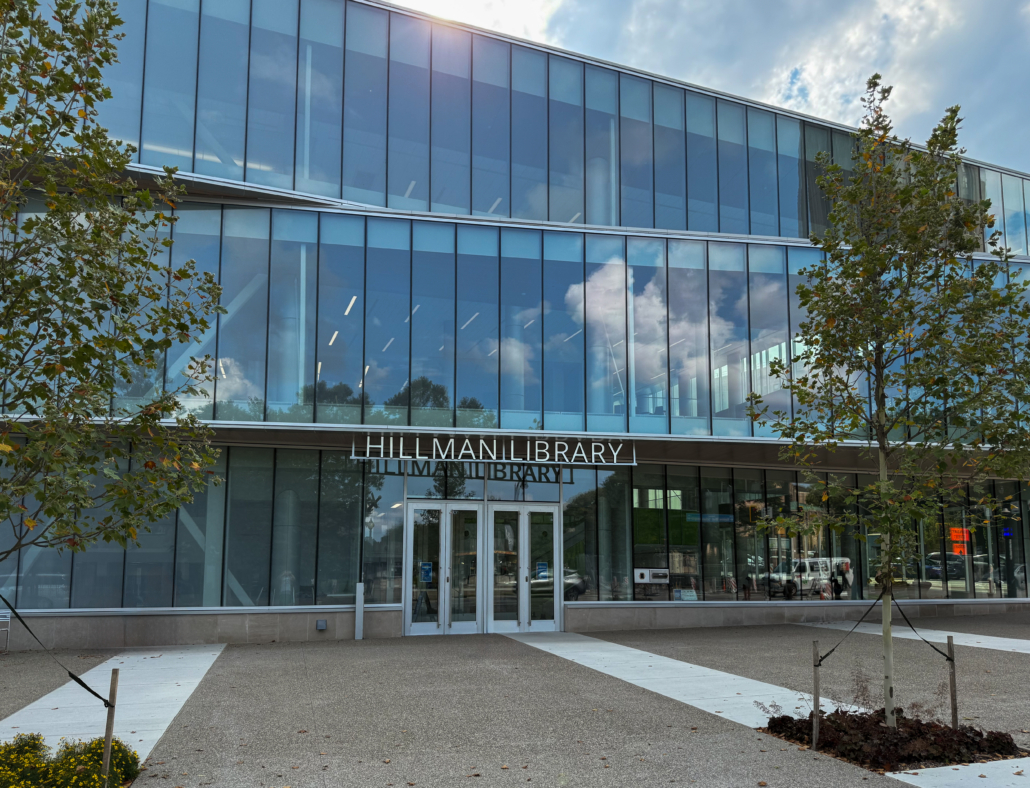
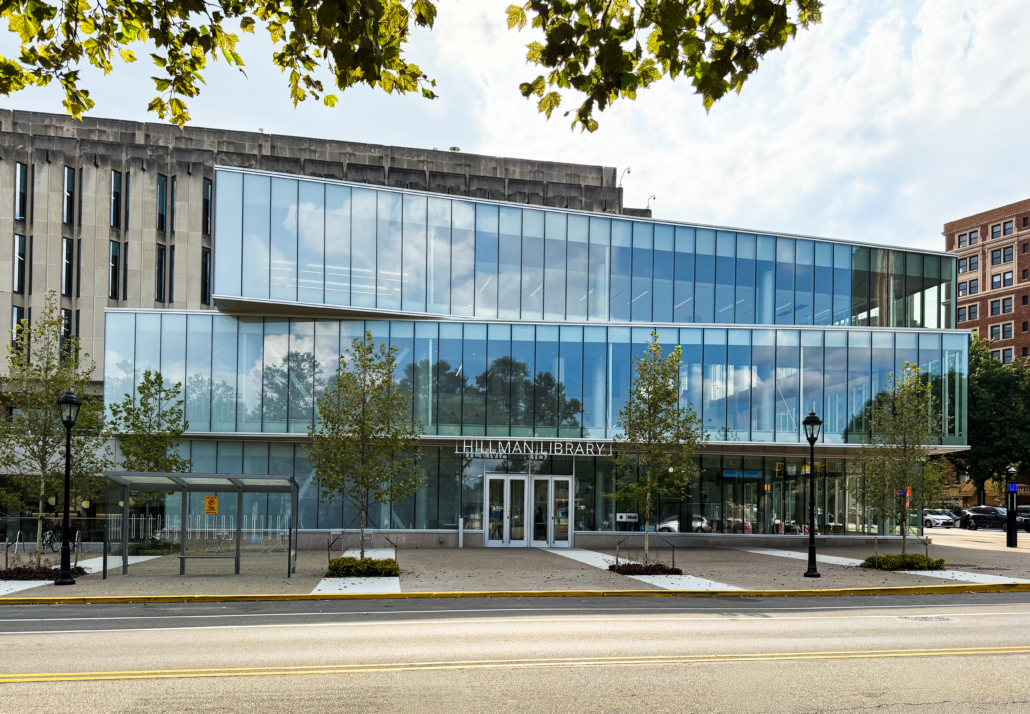
Hillman Library, Pittsburgh, PA.
Located in the heart of Pittsburgh’s Oakland neighborhood, Hillman Library at 3960 Forbes Avenue stands as a cornerstone of the University of Pittsburgh’s academic and cultural landscape.
As part of a major modernization effort led by GBBN Architects, the library recently underwent a transformative renovation aimed at reimagining the building’s presence and purpose. Press Glass was proud to contribute to this highly visible and meaningful project by providing precision-fabricated glass products that helped bring the design vision to life.

A NEW VISION FOR A CAMPUS LANDMARK
The architectural intent for the renovation centered on turning the Hillman Library into a space of innovation and openness, one that connects the university to the surrounding urban fabric and invites the public in.
It’s meant to blur the line between the park and the university library,” said Matthew Plecity of GBBN Architects.
This idea of openness was physically embodied in a newly added glass entry volume at the building’s northeast corner, strategically placed at one of the most heavily used intersections in Pittsburgh.
According to Plecity, this design move created, “the most fluid way to steer people in,” enhancing accessibility while showcasing the building’s transformation”
enhancing accessibility while showcasing the building’s transformation.
The renovation was not just aesthetic, it was performative. The glass addition served multiple roles: softening the building’s previously heavy appearance, improving acoustic performance in a bustling urban location, and optimizing natural daylight in interior spaces while minimizing thermal load.
PROJECT SCOPE AND COLLABORATION
Press Glass worked with glazier HB Reynolds to fabricate and supply approximately 15,000 square feet of glass for the renovation, with a significant portion dedicated to the new entry volume. The project called for digitally printed glass fabricated with 10mm Starphire® low-iron glass, chosen for its remarkable clarity and color neutrality; key attributes in achieving the desired visual lightness and fidelity of the printed pattern.
Each lite of glass was custom-printed using Dip-Tech technology, featuring a fading frit pattern that played a major role in both aesthetics and performance.
“Every lite had its own file and artwork,” noted Matt Stinnett, Project Manager at Press Glass. “The prints weren’t repeated. Each one had a customized layout, and the idea was for the print opacity to fade across the façade to create an elegant gradient.”
Architect: GBBN Architects
FROM CONCEPT TO REALITY
This ombre frit pattern was not just a design flourish, it was a deliberate architectural statement.
“The frit dissipates as you get to the northeast corner. And that’s meant to be in the reversed shape of the Cathedral of Learning,” said Plecity. “It outlines and leads to the clear view of the corner, which is directly at the Cathedral, so that your view is focused there.”
Executing this design with precision required close coordination between architect, glazier, and fabricator. Press Glass worked through sample development to fine-tune both the visual and performance properties of the glass. This included producing samples with both frit and Low-E coatings to help the client visualize how the completed product would appear under real-world lighting conditions.
Justin D’Alessandro, National Architectural Manager at Vitro noted, “Coordinating submittals and sending them to the architect was a huge benefit and getting them there quickly was key. Being able to separate the frit and low-e achieved the desired look and it worked well with the Vitro’s Starphire® low-iron glass.”
Being able to show those real-world samples handed around in a meeting to look at it in the daylight condition was really important,” Plecity emphasized. “Pitt maybe had one other building that had frit on it, so this was still a new concept for them.”
GLASS THAT PERFORMS
While the frit design delivered a powerful aesthetic gesture, it also played a critical role in the building’s performance.
“We are on track for LEED Platinum, and a lot of people ask, how do you get LEED Platinum on an all-glass building? The frit is one of the answers,” Plecity said. By reducing solar heat gain by 40–50%, the frit allowed the design team to downsize the air handling systems, contributing significantly to energy efficiency goals.
Balancing daylighting goals, energy code compliance, and thermal performance was no small feat.
“We rely on folks like Press Glass to walk that line between the best performance we can get and still achieve the architectural and aesthetic goals,” Plecity remarked.
This collaboration resulted in a building envelope that effectively manages Pittsburgh’s variable climate while creating a bright, inviting atmosphere for users.
SUBTLY DESIGNED SUCCESS
At Press Glass, we understand that glass is not only a building material, but also a design medium capable of expressing intent, shaping experience, and enhancing performance. The Hillman Library project exemplifies what can be achieved when fabrication expertise meets architectural innovation.
“The ombre effect set the tone for the space,” Stinnett added. “It’s the kind of detail that you may not notice at first, but once you see it, it changes how you experience the building.”
From custom digital print fabrication to thermal performance optimization, Press Glass was honored to help realize a vision that redefines what a modern university library can be: transparent, connected, and forward-looking.
